
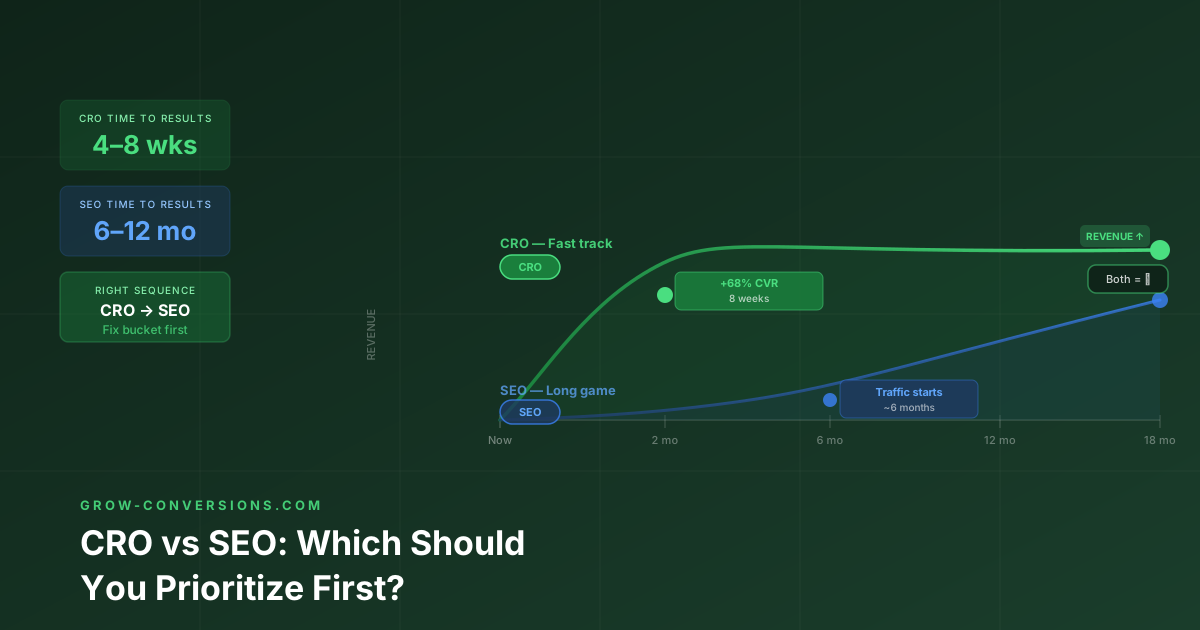
Traffic without conversion is a vanity metric. Conversion without traffic is a ceiling. You need both — but you can only prioritize one at a time, and the order matters more than most businesses realize.
If you’re not sure what CRO involves, read What Is Conversion Rate Optimization first. For low-traffic sites specifically, see CRO for Low Traffic Websites.
Invest in SEO before your site converts? You’re paying to drive traffic into a leaking bucket. Fix conversions before your site has traffic? You’re optimizing pages almost nobody visits.
Here’s the framework for making the right call — based on where your business actually is right now.
CRO vs SEO: What’s the Difference?
SEO (Search Engine Optimization) increases the number of people who find your site through organic search. More traffic → more potential customers.
CRO (Conversion Rate Optimization) increases the percentage of visitors who take the action you want. Same traffic → more revenue.
Both grow revenue. Neither replaces the other. The question is which one to do first, and how to sequence them as your business scales.
| SEO | CRO | |
|---|---|---|
| Goal | More visitors | More conversions from existing visitors |
| Time to impact | 3–12 months (long-term) | 2–8 weeks (short-term) |
| Primary lever | Content + backlinks | UX + copy + trust |
| Scales with | Domain authority over time | Revenue from existing traffic |
| Risk | Algorithm changes | Wrong hypothesis, false test results |
| Investment type | Content creation, link building | Research, testing, design |
The Fundamental Principle: Fix the Bucket Before You Fill It
Imagine you’re filling a bucket with a hole in the bottom. You can pour water faster (more traffic via SEO) — but until you fix the hole (conversion rate), most of what you pour in escapes.
The “fix the bucket first” argument is compelling — but it’s not always correct. The decision depends on your current situation.
When to Prioritize SEO First
You have less than 500 visitors/month.
CRO requires data. Heatmaps need sessions to populate. A/B tests need traffic to reach significance. User behavior analytics need visitors to be meaningful.
If you’re under 500 monthly visitors, you don’t have enough signal to do meaningful CRO. Qualitative research (user testing, surveys) still works, but it’s limited without traffic patterns to validate against.
In this case: invest in SEO to build your traffic base. Set a traffic threshold (1,000–2,000 sessions/month) before starting a formal CRO program.
You’re in a content-driven industry where traffic = authority.
For blogs, media sites, SaaS products with a content moat, or B2B companies where trust is built through education — SEO is infrastructure. Without it, you don’t get the audience that eventually converts.
Here, SEO and CRO run in parallel, but SEO is the priority investment because without authority, conversions can’t scale.
Your product is genuinely undiscovered.
If your target customers don’t know a solution like yours exists, they’re not searching for it. SEO won’t help immediately — you need demand creation. But if they’re searching and not finding you, SEO solves the discovery problem that no amount of CRO can fix.
When to Prioritize CRO First
You have traffic but low conversion rate (below industry benchmark).
If 5,000 people visit your site each month and only 40 convert (0.8% CVR), the math of fixing your CVR is compelling:
- Current: 5,000 sessions × 0.8% CVR × €80 AOV = €3,200/month
- After CRO (2.0% CVR): 5,000 sessions × 2.0% × €80 = €8,000/month
- Revenue increase: +€4,800/month — from the same traffic
Now compare that to doubling your traffic via SEO (which takes 6–12 months and significant investment) while keeping your broken CVR:
- 10,000 sessions × 0.8% × €80 = €6,400/month
CRO delivers more revenue, faster, for less cost.
You’re running paid ads to a site that doesn’t convert.
Paid ads are the clearest case for CRO first. You’re paying per click. Every visitor who doesn’t convert is a direct, measurable cost. A 1% CVR on Google Ads at €2 CPC means you’re spending €200 to generate one conversion. At 3% CVR, that drops to €67.
Fix your conversion rate before scaling paid traffic. Every percentage point you gain multiplies across your entire ad spend.
You’re about to invest in SEO content.
Here’s a sequence most teams miss: before you publish 20 new blog posts optimized for organic traffic, make sure your site converts. If your service pages, pricing page, and contact form are broken, all that incoming SEO traffic will bounce without converting.
Do a CRO audit before your content investment. Fix your on-site friction first. Then publish.
The Real Answer: Sequence, Not Choice
CRO vs SEO isn’t a binary decision — it’s a sequencing decision. Here’s the framework by stage:
Stage 1: New Business (0–500 visitors/month)
Priority: SEO (and foundational CRO)
- Build content and backlinks to grow traffic
- Fix obvious CRO issues in parallel: technical errors, value proposition, trust signals
- Don’t invest heavily in A/B testing — you don’t have the traffic yet
Stage 2: Growing Site (500–5,000 visitors/month)
Priority: CRO (while SEO continues)
- Audit your conversion funnel — where are the biggest drop-offs?
- Fix high-confidence issues first (no testing needed)
- Start qualitative research: user testing, exit surveys, session recordings
- Continue publishing SEO content, but treat CRO as equal priority
Stage 3: Established Site (5,000–20,000 visitors/month)
Priority: Both, with CRO as the growth multiplier
- Run structured A/B tests on highest-traffic pages
- CRO becomes a systematic program (test → learn → iterate)
- SEO scales with domain authority — continue building content and links
Stage 4: Scaled Business (20,000+ visitors/month)
Priority: CRO compounds, SEO protects
- CRO improvements compound: every 1% CVR gain multiplies across large volume
- SEO becomes defensive (protect rankings) and expansion (new content areas)
- CRO investment at this stage generates the highest per-pound return of any marketing spend
How CRO and SEO Reinforce Each Other
The best-performing sites don’t choose — they make CRO and SEO work together:
CRO improves SEO signals:
- Lower bounce rate (better UX = users stay longer) → positive ranking signal
- Higher pages-per-session → more crawl depth, more internal links activated
- Faster page speed (common CRO improvement) → Core Web Vitals boost
SEO enables CRO:
- Organic traffic tends to be more intent-aligned than paid — easier to convert
- Long-tail keyword content attracts high-intent visitors who are further along in the decision cycle
- Content assets (guides, comparisons, case studies) build trust that converts at higher rates
The compound effect: An e-commerce site that runs SEO and CRO in parallel over 18 months consistently outperforms sites that run them sequentially. Traffic compounds (domain authority grows), and CVR compounds (each test builds on previous learnings).
CRO vs SEO ROI: A Side-by-Side Comparison
| Scenario | Investment | Time to Results | Revenue Impact |
|---|---|---|---|
| SEO only (12 months) | €2,000–8,000 | 6–12 months | Traffic +40–100%, CVR unchanged |
| CRO only (3 months) | €1,500–4,000 | 4–8 weeks | Traffic unchanged, CVR +30–80% |
| CRO first, then SEO | €3,000–8,000 | 2–12 months | CVR improved, traffic grows on a converting site |
| Parallel (both) | €4,000–12,000 | 2–12 months | Maximum compound effect |
Estimates based on freelance/agency market rates and typical results for SMB sites. Results vary significantly.
The strongest ROI sequence for most growing businesses:
- CRO audit (4–6 weeks) — identify and fix the biggest conversion leaks
- SEO content program (ongoing) — drive organic traffic to a site that now converts
- Structured A/B testing (once traffic thresholds are met) — systematic, compound optimization
Not sure whether CRO or SEO is your bottleneck?
A CRO audit answers the question with data — not guesswork. I’ll analyze your funnel, identify your biggest revenue leaks, and tell you exactly where to invest next.