
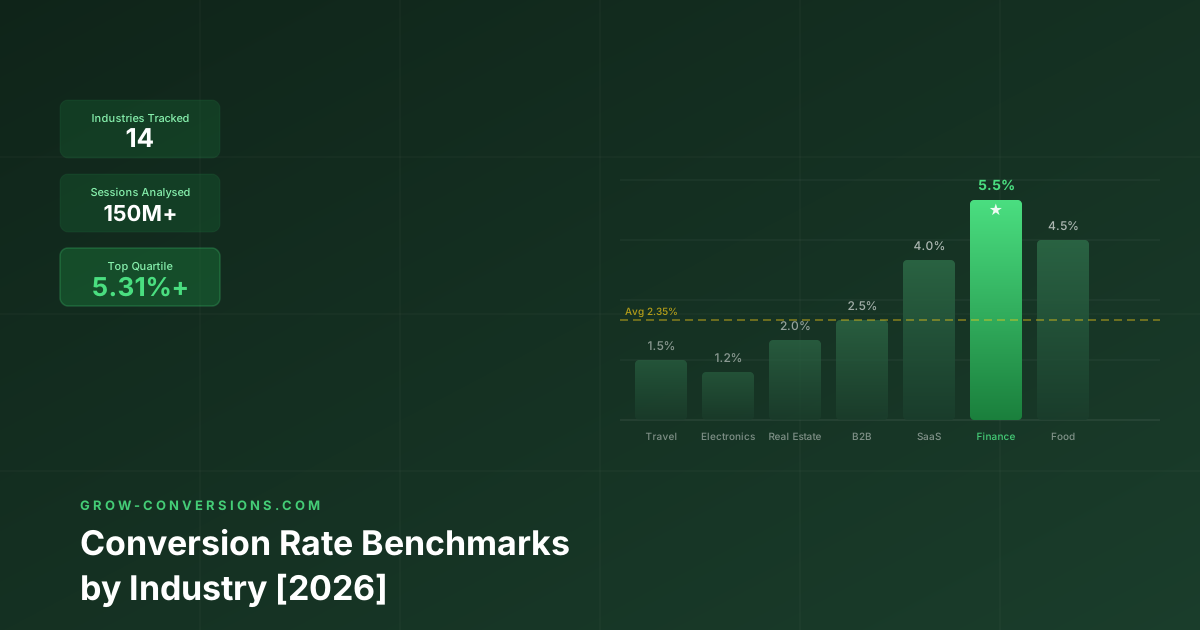
Ecommerce conversion rates cluster between roughly 1% and 4% depending on industry — but the spread inside a single vertical is wider than the gap between verticals. A benchmark only means something once you match it on industry, device, traffic source and price point. Below are the numbers, and the four conditions that decide whether they apply to you.
A few months ago I was reviewing an ecommerce store that was converting at 2.1%. The owner was embarrassed by it — convinced they were failing. Turned out they sell luxury furniture. The global benchmark for that category sits around 0.87–1.2%. They were nearly double the average and didn’t know it.
That’s the problem with conversion rate benchmarks: without context, they’re just noise. A 3% CVR is embarrassing in food and beverage, strong in fashion, and outstanding in furniture. The headline global average — usually cited somewhere between 2% and 3% — hides more than it reveals.
I’ve been doing CRO work since 2018, across 50+ businesses and 800+ A/B tests. What I’ve learned is that benchmarks are most useful as a starting point for the conversation, not as targets you optimize toward. So in this guide I’m going to share the actual numbers across ecommerce, B2B, SaaS, and digital channels — and I’ll tell you what the studies don’t mention.
Why Is Most Benchmark Data Misleading?
The studies you’ll find online — Unbounce, IRP Commerce, Dynamic Yield, WordStream — are genuinely useful. I cite them in my audits. But they have a shared limitation: they aggregate across wildly different contexts.
“Ecommerce” as a category includes a Shopify store selling €20 phone cases and a bespoke jewellery brand selling €2,000 rings. Both land in the same benchmark bucket, which is part of why the ranges are so wide. When Littledata says the average Shopify CVR is 1.4%, that’s technically accurate and practically almost useless for diagnosing your specific situation.
The number that matters is: what’s the benchmark for your category, your price point, your traffic channel, and your offer complexity? Strip those four things down and the relevant comparison gets much narrower — and much more useful.
Global Averages: The Starting Point
Before drilling into specifics, here’s a quick orientation across business models:
One thing worth clarifying upfront: are you measuring CVR by sessions or by unique users? Unique users always gives you a higher number. Sessions are messier but give you a more honest read of daily performance. When I compare across clients, I use sessions — it’s the more conservative and more actionable metric.
To calculate your conversion rate, divide conversions by total sessions (or visitors), multiply by 100. Simple in theory, surprisingly contested in practice once you factor in multi-device journeys and attribution windows.
E-Commerce Conversion Rate Benchmarks
The global ecommerce average sits somewhere between 1.64% and 2.76% depending on which study you use — IRP Commerce tends to land lower, Dynamic Yield higher. I’d put the working average at 2–2.5% for most online retailers.
But the category split tells a more interesting story.
By product category
Low-consideration, high-frequency purchases convert far better than high-consideration, high-price ones. This is obvious in hindsight, but I still see businesses comparing themselves to global averages when their category is inherently lower-CVR.
| Ecommerce category | Average CVR |
|---|---|
| Food & Beverage | 5.83% |
| Beauty & Personal Care | 4.30% |
| Fashion & Apparel | 2.88% |
| Consumer Goods | 2.21% |
| Luxury & Jewellery | 0.87% |
Source: Dynamic Yield Ecommerce Benchmarks
When I audited Filotea — an Italian pasta brand — they were at 1.4%. That looks below the 2.76% global average until you narrow it down: premium food, average order value around €45, mostly cold traffic from paid ads. In that context, 1.4% was actually reasonable. We ended up at 3.6% over 90 days, primarily by reworking the product pages and simplifying checkout from four steps to two. The benchmark told us there was room. The audit told us where.
Shopify-specific numbers
Littledata tracks Shopify stores specifically, which is more useful than aggregate ecommerce data if you’re on that platform:
| Shopify segment | CVR |
|---|---|
| Bottom 20% | Below 0.4% |
| Average | 1.4% |
| Top 20% | 3.2%+ |
| Top 10% | 4.7%+ |
Source: Littledata Shopify Benchmarks
If you’re below 0.4%, the issue is almost never design or UX. In my experience, stores that far below average have a traffic quality problem — they’re sending unqualified visitors from broad ad targeting or irrelevant keywords. Fix the traffic before you touch the site.
Desktop vs. mobile
Mobile drives 65–75% of ecommerce visits and converts at roughly two-thirds the rate of desktop:
Source: Contentsquare Digital Experience Benchmark
The mobile gap is real, persistent, and mostly fixable. People browse on mobile, buy on desktop — but only when the mobile experience is bad enough to make them switch. Close that gap and you’re not competing for more traffic, you’re monetising the traffic you already have. For a full breakdown of where mobile funnels usually break, see mobile conversion rate optimization.
B2B and SaaS Conversion Benchmarks
B2B is a different animal. The first conversion on a B2B site is rarely a purchase — it’s the start of a sales process that plays out over weeks. So “website CVR” in B2B really means form completion rate or demo request rate, not revenue.
The average B2B website conversion rate sits between 2–5% (Ruler Analytics). Legal services can hit 7%+; complex B2B SaaS averages around 1.1%. The gap between sectors is wider than in ecommerce.
What actually matters more in B2B is how leads move through your pipeline after that first form submission.
SaaS trial conversion benchmarks
For SaaS specifically, the trial model shapes everything. The numbers look dramatically different depending on how the trial is structured (First Page Sage):
That 48.8% opt-out figure always surprises people. It’s not magic — you’re only counting users who are committed enough to enter a card. The denominator is smaller. But the quality of those trials is significantly higher, which is why the model works for some products and not others.
B2B funnel stage benchmarks
The sales pipeline stage conversions tell you more than website CVR in B2B:
| Funnel stage | Average conversion rate |
|---|---|
| Lead to MQL | 37–41% |
| MQL to SQL | 13–21% |
| SQL to Opportunity | 50–60% |
| Opportunity to Close | 15–25% |
MQL to SQL is where most B2B funnels leak. I saw this clearly with Forte Solar — a B2B solar company whose overall CVR was 3.2%, which looked fine on paper. When we mapped the full funnel, the real problem was that qualified leads were getting lost in a slow, generic contact form process. Restructuring the landing page around high-intent signals and streamlining the form qualification moved them to 7.8% — not through design changes alone, but by making it immediately obvious to the right visitor that this page was for them.
For a full breakdown of how B2B funnels differ from ecommerce, see the B2B conversion rate optimization guide.
Conversion Benchmarks by Channel
Where your traffic comes from is at least as important as what you do with it once it arrives. Here’s how the main channels rank on conversion rate:
| Traffic channel | Average CVR |
|---|---|
| Email (to landing pages) | 19.3% |
| Facebook Lead Ads | 7.72% |
| Google Ads (paid search) | 7.52% |
| Organic search (SEO) | ~2.8% |
| Social media (standard) | 1.2–2.9% |
Sources: Unbounce 2024 Benchmark Report, WordStream 2025 Google Ads Benchmarks, First Page Sage
The pattern here isn’t surprising once you think about it: channels that capture existing intent — or leverage an existing relationship — consistently outperform interruption channels. Someone searching “best CRO agency for ecommerce” is already in buying mode. Someone scrolling Instagram isn’t.
Google Ads by industry
Paid search sits at 7.52% on average (WordStream 2025), but the industry spread is dramatic:
| Google Ads industry | Average CVR | Average CPL |
|---|---|---|
| Automotive — Repair | 14.67% | €28.50 |
| Animals & Pets | 13.07% | €31.82 |
| Physicians & Surgeons | 11.62% | €56.83 |
| Education & Instruction | 11.38% | €90.02 |
| Beauty & Personal Care | 7.82% | €60.34 |
| Real Estate | 3.28% | €100.48 |
| Furniture | 2.73% | €121.51 |
| Finance & Insurance | 2.55% | €83.93 |
High CVR + low CPL = service businesses where the intent signal is obvious and the offer is local. Complex or expensive products have lower CVR but presumably higher LTV to compensate.
Email converts at 19.3% to landing pages, which is roughly 7x better than SEO traffic. The reason isn’t mysterious: you’re talking to people who already opted in, already know you, and are presumably on your list because they care about something you offer. It’s the most underinvested channel in most of the businesses I audit.
If your email list isn’t generating at least 3–4x what you’d expect from the same number of cold visitors, the problem is almost certainly the content and sequencing, not the list itself.
Landing Page and Micro-Conversion Benchmarks
Not every conversion is a purchase. Before someone buys, they usually take several smaller steps — and knowing where those micro-conversions sit helps you find where the funnel is leaking.
The headline figure is the Unbounce median landing page CVR of 6.6% across all industries. Top performers sit above 11%. Generic website pages — not dedicated landing pages — average closer to 1.7% for form submissions.
Some other micro-conversion benchmarks worth knowing:
- Add-to-cart rate: 8–10% average
- Checkout completion rate: 40–50%; top performers above 73% on desktop (Bold Commerce)
- Form completion rate (once started): ~66% (Zuko)
- Form start rate (visitors who see and interact with the form): ~45%
That last one is worth sitting with. Almost half of people who see a form don’t even start it. That’s not a completion problem — that’s a motivation problem. The form is visible but the visitor isn’t convinced yet that it’s worth their time.
What I’ve Actually Seen Move the Needle
After running 800+ A/B tests across ecommerce, SaaS, and B2B clients, I can tell you what the benchmark studies don’t: what types of changes actually produce wins.
Checkout simplification is the highest-ROI category of CRO work, by a wide margin. It wins more often and at larger magnitudes than headline tests, imagery tests, or colour changes. If your checkout has more than three steps or asks for information before it’s needed, that’s the first place I’d look. In Filotea’s case, cutting from four checkout steps to two accounted for roughly 60% of the total CVR improvement.
The second biggest category is trust signals, specifically their placement. Most businesses have testimonials and trust badges somewhere on the page — usually buried below the fold or in the footer. Moving them next to the CTA consistently outperforms adding new testimonials. It’s not what social proof you have, it’s where it appears relative to the decision moment.
The third is traffic-offer mismatch — which technically isn’t a CRO fix, it’s a media buying fix, but it shows up constantly in CRO audits. Stores converting below 0.5% almost universally have a significant share of traffic arriving on pages that don’t match what they searched for or clicked on. Before touching the site, it’s worth running a CRO audit to separate funnel problems from traffic problems.
For education businesses, the dynamic is different. Korak Ispred went from 4.6% to 10.9% enrolment CVR over eight weeks — but the wins there were almost entirely about reducing friction in the information phase. Prospective students had too many unanswered questions before reaching the enrolment form. More content, clearer programme structure, faster access to pricing — 19 specific friction points resolved, and the CVR more than doubled.
What Is a Good Conversion Rate for Your Business?
The global ecommerce average is around 2.76%. If you’re at 3%, you’re above average. If you’re at 1.5%, you’re below. But neither of those facts tells you whether CRO should be your next investment or whether you should focus on traffic first.
The better question is: what’s the revenue impact of closing the gap? If you’re driving 10,000 sessions a month at 1.5% CVR with a €60 average order value, moving to 3% means an extra €9,000/month in revenue from the same traffic. That’s the number that makes the case for CRO investment — not the benchmark comparison.
Use these numbers to understand where you stand, then use the revenue math to decide what to do about it. Calculating your conversion rate and running it through a CRO ROI calculator gives you the actual business case.
These benchmarks are baselines. The top performers in every category — the ones at 4–5% ecommerce CVR, the SaaS businesses at 25%+ free trial conversion — didn’t get there by optimizing toward the average. They got there by running structured tests, fixing specific problems, and compounding small improvements over time. That’s what CRO work actually looks like in practice.
Related reading:
- CRO Audit Checklist: 37 Questions to Find Every Conversion Leak
- A/B Testing Best Practices
- Mobile Conversion Rate Optimization
- B2B Conversion Rate Optimization: The Complete Guide
- How to Reduce Cart Abandonment Rate
Want to know how your site compares in your specific category? Get a free CRO audit → — I’ll benchmark your funnel against your actual sector and show you where the biggest opportunity is.