
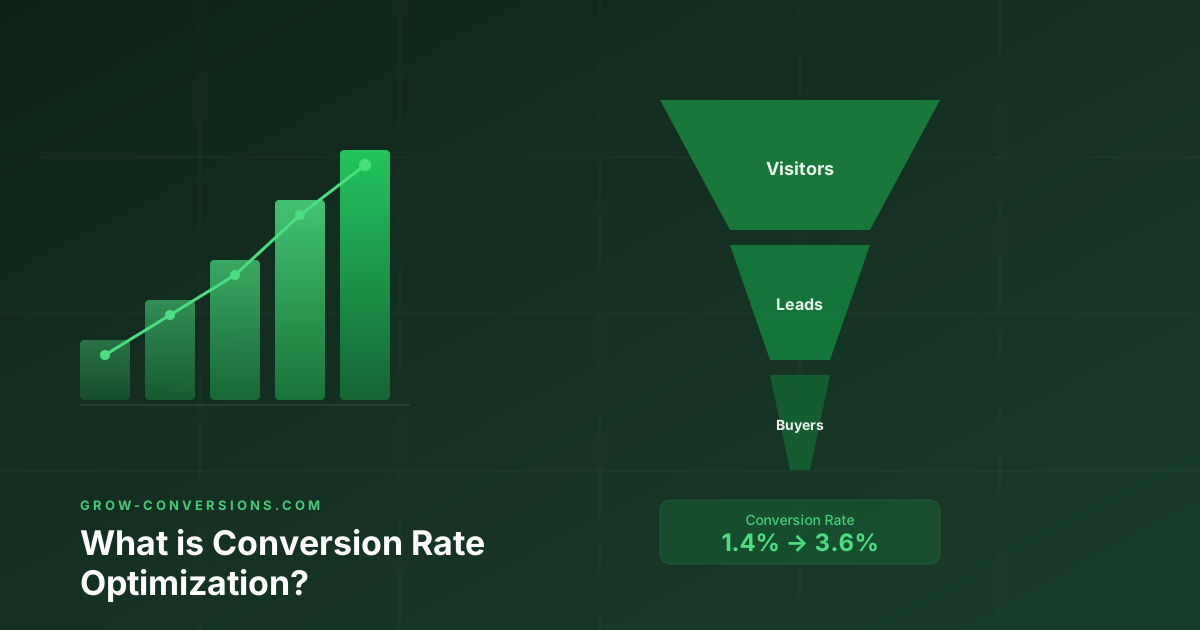
Conversion rate optimization is the practice of increasing the share of visitors who complete a desired action, using research and controlled testing rather than opinion. It works on traffic you have already paid for, which is why it usually returns faster than buying more of it.
You’re spending thousands to get traffic. Your analytics show healthy visitor numbers. But revenue isn’t moving.
That’s the problem conversion rate optimization (CRO) solves — and it’s the highest-leverage thing most businesses aren’t doing.
In this guide, you’ll learn exactly what CRO is, why it consistently outperforms traffic growth as an investment, and how to build a CRO program that compounds results over time.
What Is Conversion Rate Optimization?
Conversion rate optimization is the systematic process of increasing the percentage of website visitors who take a desired action — making a purchase, filling out a form, starting a free trial, or any other goal that matters to your business.
The conversion rate formula is:
Conversion Rate = (Conversions ÷ Total Visitors) × 100
If 1,000 people visit your landing page and 30 of them buy, your conversion rate is 3%.
CRO is the discipline of moving that number from 3% to 4%, 5%, or higher — without spending more on traffic.
What Counts as a “Conversion”?
A conversion is any meaningful action a visitor takes. There are two types:
Macro conversions — your primary business goal:
- Purchase completed
- Lead form submitted
- Free trial activated
- Phone call placed
Micro conversions — intermediate steps that predict macro conversion:
- Email newsletter signup
- Add to cart
- Product page view
- Pricing page visit
- Video played
Tracking micro conversions matters because they let you optimize the path to conversion, not just the endpoint. If 40% of visitors who visit your pricing page eventually buy, and only 8% of homepage visitors visit pricing, then getting more people to the pricing page is a high-leverage optimization — even before you touch the pricing page itself.
Why Is CRO a Better Investment Than More Traffic?
Here’s the math every marketing team should understand:
| Scenario | Monthly Visitors | CVR | Monthly Revenue |
|---|---|---|---|
| Status quo | 10,000 | 2% | £20,000 |
| +50% more traffic | 15,000 | 2% | £30,000 |
| +50% higher CVR | 10,000 | 3% | £30,000 |
Same revenue outcome. But the traffic route costs ongoing ad spend every month, while the CVR improvement is permanent. Once you move a conversion rate from 2% to 3%, every future visitor benefits from that change. Forever.
The compounding effect gets more powerful over time:
| Quarter | CVR | Monthly Revenue (same traffic) |
|---|---|---|
| Q1 | 2.0% | £20,000 |
| Q2 | 2.5% (one test win) | £25,000 |
| Q3 | 3.1% (another win) | £31,000 |
| Q4 | 3.8% (another win) | £38,000 |
Three test wins over a year, same traffic and ad spend, produces a 90% revenue increase. This is why companies with serious CRO programs grow faster than those that only invest in traffic acquisition.
CRO vs. SEO vs. Paid Ads: What’s the Difference?
People often ask how CRO fits with their other marketing channels. Here’s the honest answer:
SEO and paid ads bring visitors to your site. CRO determines what happens when they arrive.
| Channel | What it does | Cost model | Effect duration |
|---|---|---|---|
| SEO | Increases organic traffic | Time + content investment | Ongoing (slow build) |
| Paid Ads | Increases paid traffic | Cost-per-click | Immediate, stops when you stop paying |
| CRO | Increases % of visitors who convert | Time + testing | Permanent once implemented |
The three channels complement each other. SEO brings more organic visitors; CRO converts more of them. Paid ads bring targeted traffic; CRO makes sure that expensive traffic actually generates revenue.
A business running paid ads without CRO is leaving money on the table — paying for traffic and converting a fraction of what’s possible. A business doing only CRO without traffic growth has a ceiling. The combination is where the real leverage is.
CRO by Business Type
The CRO process is universal, but the specific tactics and priorities vary by business model.
CRO for Ecommerce
In ecommerce, conversion rate is most commonly measured as purchases ÷ sessions. The average ecommerce CVR is 2.5–3%, with top performers above 5%. For a wider reference point, Contentsquare’s 2026 Digital Experience Benchmark — 99 billion sessions across more than 6,000 sites — puts returning visitors at 2.9% and new visitors at 1.7%, which is a useful reminder that a single sitewide number hides a very large split.
The highest-leverage areas for ecommerce CRO:
- Product pages — clarity of value, photo quality, social proof placement
- Cart and checkout — friction reduction, guest checkout, payment options
- Mobile experience — the mobile-desktop CVR gap is typically 2:1 or worse
- Category pages — filtering, sorting, product display density
If you want a deep dive into ecommerce specifically, read our ecommerce conversion rate optimization guide.
CRO for SaaS
SaaS businesses have multiple conversion points: visitor → trial/signup, trial → paid, free → upgrade. Each step is a separate optimization opportunity.
The highest-leverage areas:
- Homepage and pricing page — clarity of value proposition, plan comparison
- Trial onboarding — activation rate (getting users to the “aha moment”)
- Upgrade prompts — timing, triggers, and framing
- Cancellation flow — recovery and pause options
SaaS companies typically care about both CVR and trial-to-paid rate. An increase in the latter is often worth more than an increase in top-of-funnel CVR.
CRO for Lead Generation
B2B and service businesses generate leads, not direct purchases. The conversion rate measures how many visitors submit a form, book a call, or request a quote.
The highest-leverage areas:
- Landing pages — offer clarity, form length, trust signals
- Lead magnets — content upgrades, free tools, calculators
- Contact/booking pages — friction reduction, reassurance copy
- Chat and chatbots — real-time conversation before commitment
Lead gen businesses should also optimize downstream — not just who fills out the form, but who converts to a client. High form fill rate plus low close rate often means the wrong leads are converting. That’s a targeting and qualifying problem, not a traffic problem.
Econsultancy research found that companies with a structured approach to CRO are more than twice as likely to see a large increase in sales. Yet most businesses allocate less than 5% of their marketing budget to conversion — compared to 95% spent on acquiring the traffic in the first place.
How Does the CRO Process Actually Work?
Professional CRO isn’t just changing button colors and hoping for the best. It follows a rigorous, repeatable process.
Step 1: Research & Data Collection
Before changing anything, you need to understand why visitors aren’t converting. This means gathering both quantitative and qualitative data:
Quantitative research:
- Google Analytics 4 funnel analysis — where do users drop off?
- Heatmap analysis — where do they click, how far do they scroll?
- Session recordings — what do they actually do?
- Form analytics — which fields cause drop-off?
Qualitative research:
- User surveys — what stopped you from completing your purchase?
- Customer interviews — why did you decide to buy?
- Support ticket analysis — what are users confused about?
- Sales call recordings — what objections come up repeatedly?
The best CRO insights come from combining both. Quantitative data shows you what is happening. Qualitative data shows you why.
Step 2: Hypothesis Formation
Based on your research, you form a structured hypothesis:
“Because we observed [data], we believe that [change] will result in [outcome] for [segment].”
Example: “Because session recordings show 60% of mobile users don’t scroll past the hero section, we believe adding a visible scroll indicator will increase scroll depth and CTA click rate for mobile visitors.”
A well-formed hypothesis has three components:
- The observation that prompted it (data, not intuition)
- The specific change being proposed
- The expected outcome and segment
Without a structured hypothesis, you’re just changing things randomly and calling it optimization.
Step 3: Prioritization
You’ll always have more hypotheses than you have time to test. Prioritize using the PIE framework:
- Potential — How much improvement is possible on this page?
- Importance — How much traffic and revenue does this page drive?
- Ease — How complex is this to build and run?
Score each hypothesis 1–10 on each dimension. The average score determines priority. This removes subjective debate about what to test and focuses resources on the highest-expected-value work.
Step 4: Experimentation
Most CRO tests are A/B tests (also called split tests): two versions of a page or element, shown to equal halves of your traffic, with performance compared statistically.
For a test to be trustworthy:
- Sample size: Calculate required visitors before starting. Don’t stop early.
- Duration: Run for at least 2 full business cycles (typically 2 weeks minimum)
- Significance: Reach 95%+ statistical confidence before declaring a winner
- One variable: Change one thing per test so you know what caused the lift
For more detail on running statistically rigorous tests, read our A/B testing best practices guide.
Step 5: Analysis & Implementation
When a test reaches significance:
- Implement the winner site-wide
- Document the result: what won, by how much, why you think it worked
- Generate follow-up hypotheses based on what you learned
When a test loses:
- Document why the hypothesis didn’t hold
- Look for segment differences (maybe it lost overall but won on mobile)
- Form a new hypothesis
A losing test isn’t a failure — it’s data. The businesses that run 100 tests with 30 winners have dramatically more insight than those who run 10 tests with 8 winners. Volume of learning compounds.
Common CRO Mistakes to Avoid
Mistake 1: Optimizing Without Sufficient Traffic
Running A/B tests on pages with low traffic produces unreliable results. If you’re getting 200 visitors per month to a page, you don’t have enough data to detect meaningful differences — tests will take months to reach significance, and results will be noisy.
Fix: Focus first on your highest-traffic pages. Build a measurement framework before testing. Consider qualitative methods (surveys, user interviews) when traffic is too low for A/B tests.
Mistake 2: Cosmetic Changes Over Structural Ones
Button colour tests rarely produce significant lifts. The highest-impact CRO changes are structural:
- Headline rewrites that fundamentally change the value proposition
- Offer restructuring (pricing, packaging, guarantee)
- Social proof repositioning
- Form simplification
- Above-fold content for mobile
If your test backlog is full of colour and font tests, you’re playing CRO theatre, not CRO.
Mistake 3: Testing Without a Hypothesis
Random testing (“let’s try adding a video and see what happens”) produces wins that can’t be replicated or learned from. If a test wins but you don’t know why it won, you can’t apply that insight to the next test.
Always start with a research-backed hypothesis. The test is how you prove or disprove it.
Mistake 4: Ignoring the Full Funnel
A 10% lift on a product page means nothing if the checkout is converting at 30% of what it should. CRO work should start at the biggest leak in the funnel, not at the first page a user sees.
Map your funnel, identify the step with the highest drop-off, and start there.
Mistake 5: Treating Tests as One-Off Projects
CRO compounds when it’s a continuous program, not a series of one-off projects. Each test should inform the next. A culture of experimentation — where every significant change gets tested — is the sustainable competitive advantage.
What’s a Good Conversion Rate?
The only honest answer: it depends on your industry, traffic source, offer type, and price point.
General benchmarks:
- Ecommerce: average 2–3%, top performers 5–8%
- SaaS free trial: average 5–8%, top performers 15%+
- Lead gen landing page: average 5–12%, top performers 25%+
- Paid search landing pages: average 4–8%, top performers 12%+
For comprehensive industry benchmarks, read: Conversion Rate Benchmarks by Industry: 2026 Data.
The most useful benchmark is your own baseline. Moving from 2% to 2.6% is a 30% improvement regardless of what industry averages say — and a 30% improvement on the same traffic is a 30% revenue increase.
What Tools Do You Need for CRO?
A minimal but effective CRO stack covers three areas:
- Analytics: Google Analytics 4 (free) — funnel analysis, traffic source segmentation
- Qualitative research: Microsoft Clarity (free) or Hotjar — heatmaps, session recordings, surveys
- A/B testing: VWO, AB Tasty, or Convert — for running statistically rigorous experiments
You don’t need everything at once. Start with GA4 and Clarity. Once you have hypotheses ready to test, add an A/B testing tool.
For a full breakdown, read: Best CRO Tools in 2026: Honest Review.
How Do You Start With CRO?
Week 1–2: Install your measurement tools
- Set up GA4 with conversion goals and funnel exploration
- Install Microsoft Clarity or Hotjar on key pages
- Create an exit survey on your highest-exit page
Week 3–4: Do your research
- Review funnel drop-off: where does the biggest percentage leave?
- Watch 20–30 session recordings on your top exit pages
- Read the exit survey responses
- Analyse your GA4 funnel by device and traffic source
Week 5–6: Build your hypothesis backlog
- Write hypotheses for every significant finding
- Score them using PIE framework
- Design the top-priority test
Week 7+: Run your first test
- Calculate sample size before launching
- Set a calendar reminder for when to check results
- Document results in a test log
- Implement winners, generate follow-up hypotheses
The first cycle always takes longer than you expect. After it, the process becomes routine.
Frequently Asked Questions About CRO
What’s the difference between CRO and UX design?
UX design aims to create intuitive, usable experiences. CRO is specifically focused on optimizing for conversions — the actions that drive business value. The two overlap significantly, but a UX designer and a CRO specialist approach a page with different objectives. CRO practitioners use data and A/B testing to validate whether UX changes actually improve business outcomes, not just usability scores.
How long does CRO take to show results?
It depends on traffic volume and the magnitude of changes. A business with 100,000 monthly visitors running well-designed tests can see verified results in 2–4 weeks per test. A business with 5,000 monthly visitors might need 8–12 weeks per test. The process compounds over time — year one results are modest; year three results are transformative.
Can you do CRO without running A/B tests?
Yes — especially if traffic is too low for reliable A/B tests. Qualitative CRO (user research, heuristic analysis, expert reviews) identifies problems without statistical testing. Changes can be made and measured sequentially with careful before/after analysis. But A/B testing is the gold standard because it controls for external variables. Use qualitative methods to identify what to change; use A/B tests to verify that the change actually worked.
What pages should be optimized first?
Start with the highest-traffic, highest-impact pages in your funnel. Usually that’s: homepage, main landing page, product/service pages, checkout or contact page. Don’t start optimizing your About page when your checkout is leaking 65% of potential buyers.
How much traffic do you need to do CRO?
To run meaningful A/B tests, you typically need at least 500–1,000 conversions per month on the page you’re testing. Below that, tests take too long to reach significance and results are unreliable. If you’re below that threshold, focus on qualitative CRO: session recordings, user surveys, expert audits.
Ready to stop leaving revenue on the table? Our CRO audit service identifies your three biggest conversion leaks and builds the roadmap to fix them. Book a free audit →