
“Is our conversion rate good?”
It’s one of the first questions every growth team asks — and one of the least useful questions if asked without context. A 1.5% CVR is a disaster for a B2B SaaS free trial page. It’s completely normal for a mid-market e-commerce store.
Context is everything. Industry benchmarks give you that context.
Below is a compiled breakdown of conversion rate benchmarks across 14 industries, sourced from Wordstream, Unbounce’s Conversion Benchmark Report, and Littledata’s e-commerce dataset. Use these numbers to understand where you stand — then use your own historical data to set realistic targets.
What Is a Good Conversion Rate? (The Short Answer)
A good conversion rate is one that’s improving. That said, here’s the quick-reference baseline:
- E-commerce (general): 1.5–3.0% average, 5.0%+ top quartile
- SaaS free trial: 2.0–5.0% average, 8.0%+ top quartile
- B2B lead generation: 1.0–3.5% average, 6.0%+ top quartile
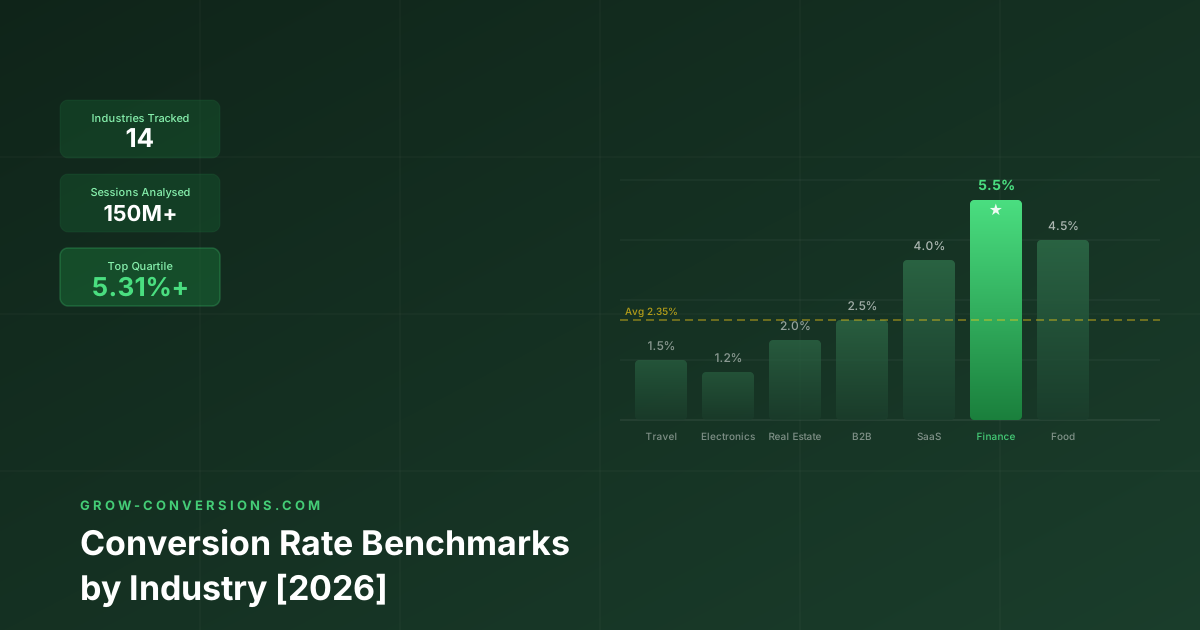
- Landing pages (all industries): 2.35% average, 5.31%+ top 25%
Source: Wordstream, 2024
If you’re above the industry average but below the top quartile, you have room to grow. If you’re at or above top-quartile performance, focus on volume and retention rather than pure CVR optimization.
Not sure how to calculate your CVR correctly? See: How to Calculate Conversion Rate.
Conversion Rate Benchmarks by Industry
E-commerce
| Segment | Average CVR | Top 25% | Top 10% |
|---|---|---|---|
| General e-commerce | 1.5–3.0% | 5.0% | 8.0%+ |
| Fashion & Apparel | 1.5–2.5% | 4.5% | 7.0% |
| Consumer Electronics | 0.8–1.5% | 3.0% | 5.5% |
| Beauty & Personal Care | 2.5–4.0% | 6.5% | 9.0% |
| Home & Garden | 1.0–2.5% | 4.0% | 6.5% |
| Food & Beverage | 3.0–5.0% | 8.0% | 12.0%+ |
| Sports & Outdoors | 1.0–2.0% | 3.5% | 6.0% |
Source: Littledata E-commerce Benchmark Report 2024, IRP Commerce data
Why consumer electronics converts so low: High price points require more research. Shoppers compare across Amazon, Best Buy, and brand sites before converting. The purchase cycle is longer, and CVR reflects that.
Why food & beverage converts high: Subscription models, repeat purchases, and impulse buys. A consumer who wants protein powder doesn’t need 6 touchpoints to decide.
SaaS & Software
| Segment | Average CVR | Top 25% | Notes |
|---|---|---|---|
| Free trial (no CC required) | 3.0–8.0% | 12.0%+ | Friction-free — highest CVR tier |
| Free trial (CC required) | 0.5–2.5% | 4.0% | Credit card gate sharply reduces CVR |
| Freemium signup | 5.0–10.0% | 15.0%+ | Low barrier, high volume |
| Demo request | 1.0–3.5% | 5.0% | Filters for high-intent prospects |
| Paid direct (no trial) | 0.3–1.5% | 2.5% | Requires strong trust signals |
Trial-to-paid conversion (the metric that matters more):
- Industry average: 15–25% of free trial users convert to paid
- Top performers: 40%+ trial-to-paid conversion
- B2B SaaS specifically: 5–15% trial-to-paid is common due to longer evaluation cycles
Source: OpenView SaaS Benchmarks 2024, Lenny Rachitsky’s Product Analysis
B2B Lead Generation
| Lead Type | Average CVR | Top 25% |
|---|---|---|
| Contact form / quote request | 1.0–3.5% | 6.0% |
| Whitepaper / content download | 5.0–15.0% | 20.0%+ |
| Webinar registration | 8.0–20.0% | 30.0%+ |
| Demo / consultation request | 1.0–4.0% | 7.0% |
| Newsletter signup | 1.5–5.0% | 8.0% |
Important caveat: Lead quality scales inversely with CVR. A whitepaper download converting at 15% generates mostly top-of-funnel contacts. A demo request at 2% generates hot prospects ready to talk budget.
Don’t optimize for quantity of leads without monitoring lead quality. A CVR jump from 2% to 4% on a demo page can be meaningless or damaging if it came from reducing qualification questions.
Finance & Insurance
Average CVR: 4.5–6.0% | Top 25%: 10.0%+
Finance consistently outperforms other sectors for one reason: high purchase intent. Someone comparing car insurance quotes has already decided to buy — they’re just choosing where. The conversion step is almost inevitable once you’ve gotten them to the quote page.
The optimization challenge in finance isn’t getting the conversion — it’s getting qualified traffic. CVR is high, but CPL (cost per lead) is also among the highest of any industry.
Healthcare
Average CVR: 2.5–4.5% | Top 25%: 7.0%+
Healthcare CVR is heavily influenced by:
- Type of service (elective vs. urgent)
- Payment model (insurance-covered vs. out-of-pocket)
- Appointment booking vs. information request
Telehealth and urgent care pages convert significantly higher than elective procedure pages, where the decision cycle is weeks or months.
Travel & Hospitality
Average CVR: 0.5–2.0% | Top 25%: 3.5%+
Travel has the lowest benchmark CVR of any major e-commerce category — and for good reason. A single booking decision involves:
- Destination selection
- Date selection
- Price comparison across 5+ platforms
- Review checking (TripAdvisor, Google, Booking.com)
- Partner or family agreement
Most users who visit a travel site are in research mode, not purchase mode. Direct booking sites compete with OTAs (Booking.com, Expedia) on both price and trust, which suppresses CVR further.
The metric that matters more in travel: return visitor CVR. Users who return to book after research convert at 3–5× the rate of first-time visitors.
Real Estate
Average CVR: 1.0–3.0% | Top 25%: 5.0%+
Real estate CVR measures lead form completions (contact agent, schedule viewing, request info) — not transactions. The purchase itself happens offline after weeks of evaluation.
High-converting real estate pages share three traits:
- Strong location specificity — “3 bedroom apartments in [specific neighborhood]” converts better than “apartments in [city]”
- Visible pricing — hiding price dramatically reduces lead quality and conversion intent
- Low-friction contact options — WhatsApp links and click-to-call outperform contact forms for mobile visitors
Education
Average CVR: 3.0–6.0% | Top 25%: 8.0%+
Online education has seen significant CVR improvement post-2020 as remote learning normalized. Courses under €200 with clear outcomes convert at the higher end of this range. Degree programs and high-ticket courses ($5,000+) convert at 0.5–1.5%.
Key insight from Unbounce Benchmark Report: Education landing pages with video testimonials convert 27% higher than those without. Social proof from real students outperforms institution credentials for purchase intent.
Landing Page Conversion Rates by Traffic Source
The same page will convert differently depending on where the traffic came from. Understanding this prevents misreading your data.
| Traffic Source | Average Landing Page CVR | Notes |
|---|---|---|
| Email (warm list) | 5.0–12.0% | Highest intent — already knows your brand |
| Paid Search (branded) | 6.0–10.0% | Name-search intent = high purchase readiness |
| Paid Search (non-brand) | 2.5–5.0% | Comparison intent — needs stronger value prop |
| Social Ads | 1.0–3.0% | Interruption-based — lower intent by default |
| Organic Search | 2.0–4.0% | Varies by keyword intent; high variance |
| Direct / Referral | 3.0–6.0% | Mix of warm leads and lost users |
| Display Retargeting | 0.5–2.0% | Second chance — warm but not urgent |
Source: Wordstream, HubSpot State of Marketing Report 2024
Practical implication: If you’re running paid social ads to a landing page and seeing 1.5% CVR, that’s not necessarily a problem with the page. It may be a targeting problem — social audiences need more warming before they’re ready to act.
How to Use These Benchmarks
Step 1: Find your industry. Calculate your current CVR from the last 30–90 days.
Step 2: Locate yourself in the tier (below average, average, top 25%, top 10%).
Step 3: Set a realistic target — moving from below average to average is more achievable than jumping from average to top 10%.
Step 4: Calculate the revenue impact of closing the gap:
Revenue opportunity = (Target CVR − Current CVR) × Monthly Sessions × Average Order Value
Example:
- Current CVR: 1.8%
- Industry average: 2.5%
- Monthly sessions: 12,000
- AOV: €85
- Revenue opportunity: (0.025 − 0.018) × 12,000 × 85 = €7,140/month in recoverable revenue
This is how you build the business case for CRO investment — and why benchmarks aren’t just interesting data, they’re revenue calculations.
Want to know why your CVR is below benchmark?
A CRO audit reveals the specific friction points pulling your conversion rate down — UX issues, copy gaps, trust problems, technical errors. Most sites I audit have 5–8 identifiable fixes before we even run a single test.
If you want to understand the full optimization process, see What Is Conversion Rate Optimization.