
Most marketers know their traffic numbers. Very few actually know their conversion rate — and the ones who do are often calculating it wrong.
Here’s the uncomfortable truth: if you’re dividing by the wrong number, your CVR is a lie. You’re optimizing for a metric that doesn’t exist.
In this guide, I’ll show you the exact conversion rate formula, walk through real examples by channel, and give you the mistakes to avoid before you start making decisions based on bad math.
New to CRO? Start with What Is Conversion Rate Optimization first, then come back here for the math.
What Is Conversion Rate? (Quick Definition)
Conversion rate is the percentage of visitors (or users, sessions, or emails) who complete a desired action — a purchase, a signup, a form submission, a call.
It answers one question: of everyone who came, how many actually did what we wanted?
The Conversion Rate Formula
The formula is simple:
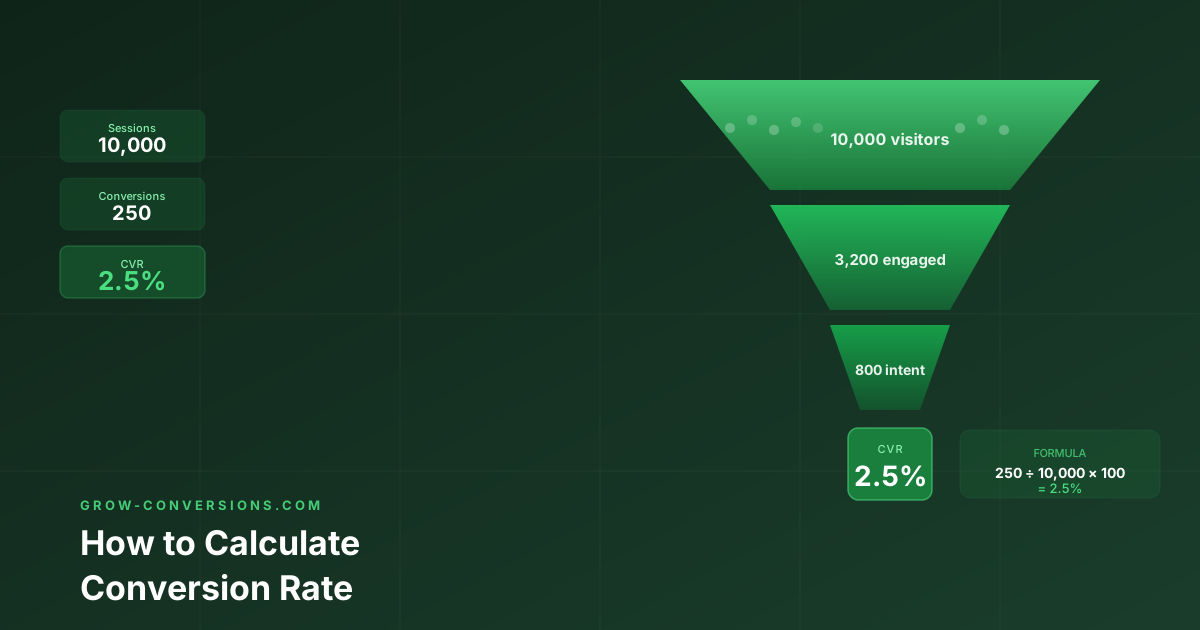
Conversion Rate (%) = (Number of Conversions ÷ Total Visitors) × 100
Example:
- 3,500 visitors to your landing page
- 140 completed the signup form
- CVR = (140 ÷ 3,500) × 100 = 4.0%
That’s it. No complexity. Where people go wrong is choosing the wrong denominator — more on that below.
Step-by-Step: How to Calculate Your Conversion Rate
- Define your conversion event. What counts as a conversion? A purchase, a lead form, a trial signup, a phone call? One metric = one CVR.
- Pull your conversion count. From GA4, your CRM, or your e-commerce platform — however many times that event fired in your chosen period.
- Pull your traffic count. Use the same period and the same source. If you’re calculating for a landing page, use page sessions — not site-wide sessions.
- Apply the formula. Divide conversions by visitors, multiply by 100.
- Segment immediately. Never look at site-wide CVR without segmenting by channel, device, or page. Blended numbers hide the real story.
Conversion Rate Formula by Channel
The formula stays the same — but what you plug in changes depending on the channel.
E-commerce Conversion Rate
E-commerce CVR = (Completed Purchases ÷ Total Sessions) × 100
Example: 18,000 sessions, 252 orders → CVR = 1.4%
Use sessions, not unique visitors. A person who visits three times and buys once generated three sessions, one conversion. That’s the reality of browsing behavior.
Landing Page Conversion Rate
Landing Page CVR = (Form Submissions ÷ Landing Page Sessions) × 100
Only count sessions to that specific page, not your entire site. Landing page CVR calculated against site-wide traffic is meaningless noise.
Email Campaign Conversion Rate
Email CVR = (Conversions from Email Clicks ÷ Total Emails Delivered) × 100
Or, if you want the click-to-conversion rate (more useful for copy optimization):
Click-to-Conversion = (Conversions ÷ Total Clicks) × 100
Lead Generation Conversion Rate
Lead Gen CVR = (Completed Lead Forms ÷ Form Page Sessions) × 100
For multi-step funnels, calculate CVR at each step, not just the final one. A 60% drop on step 2 of a 3-step form is the problem — blended funnel CVR won’t tell you that.
Conversion Rate Benchmarks by Industry
Before you panic or celebrate your number, check where you stand relative to your industry. For the full breakdown with data sources, see the Conversion Rate Benchmarks by Industry guide.
| Industry | Average CVR | Top 25% CVR |
|---|---|---|
| E-commerce (general) | 1.5–3.0% | 5.0%+ |
| SaaS (free trial) | 2.0–5.0% | 8.0%+ |
| B2B Lead Generation | 1.0–3.5% | 6.0%+ |
| Finance & Insurance | 4.5–6.0% | 10.0%+ |
| Travel & Hospitality | 0.5–2.0% | 3.5%+ |
| Education | 3.0–6.0% | 8.0%+ |
| Healthcare | 2.5–4.5% | 7.0%+ |
| Real Estate | 1.0–3.0% | 5.0%+ |
Source: Wordstream Conversion Benchmark Report, Unbounce Conversion Benchmark Report, 2024–2025 data
The benchmark that actually matters: your own historical CVR vs. this month’s CVR. Industry averages are context — not your goal.
If your e-commerce site converts at 1.2% and the benchmark is 1.5%, that gap represents thousands of euros in recoverable revenue. But if last month you were at 0.9%, you’re already winning.
Micro vs Macro Conversions: What Should You Measure?
Most sites have more than one conversion event. Measuring only the macro conversion (purchase, signup) leaves you flying blind on everything that leads to it.
| Type | Definition | Examples |
|---|---|---|
| Macro Conversion | The primary goal — the action that generates revenue | Purchase, trial signup, demo request, quote request |
| Micro Conversion | Actions that indicate progress toward the macro goal | Add to cart, watchlist, email signup, PDF download, video play, return visit |
Why micro conversions matter for CRO:
- Low macro CVR with high micro CVR = funnel problem at a specific step
- Low micro CVR = traffic quality or messaging problem (people aren’t engaging at all)
- Rising micro CVR + flat macro CVR = friction at the final step (checkout, pricing, form)
Track both. Optimize the one that moves the macro needle.
5 Common Conversion Rate Calculation Mistakes
1. Using unique visitors instead of sessions
Sessions capture repeat behavior. If someone visits your product page three times before buying, that purchase happened during one of three sessions. Use sessions unless you specifically need unique-visitor analysis.
2. Mixing traffic sources in the denominator
Site-wide CVR hides everything. Organic search CVR, paid CVR, and email CVR should be calculated separately — they have different baselines, different audiences, different copy.
3. Calculating CVR before statistical significance
100 visitors, 3 conversions = 3% CVR. That number means nothing. You need 1,000+ sessions before CVR stabilizes enough to act on. Small sample sizes create the illusion of insight.
4. Not excluding bots and internal traffic
Bots don’t convert. Internal traffic (your team browsing the site) shouldn’t inflate session counts. Filter both in GA4 before pulling numbers.
5. Comparing CVR across different time periods without checking for seasonality
December e-commerce CVR vs. February e-commerce CVR is not an apples-to-apples comparison. Always compare year-over-year, or at minimum flag seasonal periods as outliers.
Which Tool Shows Your Conversion Rate?
- Google Analytics 4: Set up conversion events → Conversions report gives you CVR by channel, page, device
- Shopify / WooCommerce: Built-in CVR in your dashboard (but use sessions, not “online store sessions” if you’re doing cross-channel analysis)
- Hotjar / Microsoft Clarity: Funnel reports show drop-off rates between steps
- Your A/B testing tool (VWO, Optimizely, Convert): CVR per variant — the most reliable context for measuring CRO impact
Pro tip: Use GA4 Exploration reports to build a custom funnel view with CVR at each step. It takes 10 minutes to set up and saves hours of manual calculation.
What to Do After You Calculate Your Conversion Rate
Knowing your CVR is step one. Here’s what to do next:
- Segment by device. Mobile CVR is almost always lower than desktop. If your mobile CVR is less than 40% of desktop CVR, that’s where you start.
- Segment by traffic source. Which channel sends the visitors who actually convert? Double down on that. Cut or fix the ones that don’t.
- Identify your biggest revenue gap. Use the formula: (target CVR − current CVR) × monthly sessions × average order value = recoverable revenue. This is how you build the business case for CRO investment.
- Run a CRO audit to find the friction points — technical issues, UX problems, copy gaps — that are suppressing your CVR.
- Set a test hypothesis. Every optimization starts with “We believe changing X will improve CVR because Y.” Don’t change things based on gut.
Ready to find what’s actually killing your conversion rate?
A CRO audit goes deeper than the formula. I’ll analyze your funnel, identify the friction points suppressing your CVR, and give you a prioritized list of fixes — starting with the ones with the highest revenue impact.